Abstract
Collaboration promises to extend humanoid capabilities beyond what individual robots can achieve. However, realizing this potential requires coordinated whole-body interactions, coherent long-horizon planning, and precise synchronization across robots. We introduce Heave-Ho, a decentralized framework for long-horizon collaborative multi-humanoid loco-manipulation. At the low level, we develop a multi-agent post-training framework that adapts a humanoid foundation tracking model to physically coupled interactions between humanoids, enabling coordinated decentralized control from local observations alone. At the high level, we train a vision-language planner and design a speech-based leader-follower coordination mechanism to synchronize decentralized execution without network communication. Trained with two identical humanoids, our system scales to teams of up to ten robots and generalizes to heterogeneous teams without retraining. To benchmark these capabilities, we introduce HH-Bench, comprising 12 tasks involving teams of 2 to 10 humanoids, including heterogeneous teams. Systematic evaluations show that Heave-Ho consistently outperforms baseline methods, while real-world experiments demonstrate robust decentralized collaboration across challenging tasks.
How it works
The leader chooses the next team skill and speaks it. Followers hear it on board, and every robot starts on a shared schedule.
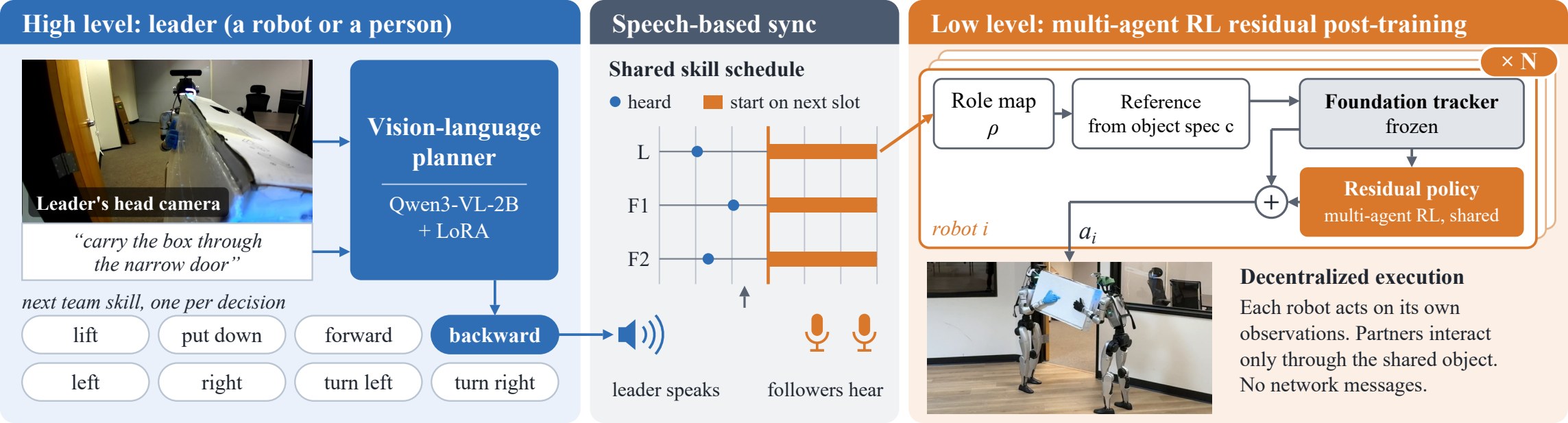
One voice, one team
Press play with the sound on. The leader speaks each command, in English and then in Mandarin. Followers hear it with on-board microphones, and every robot starts together. Either a robot or a person can lead. Spoken commands play in real time; execution is sped up and muted. The person's voice is pitch-shifted for anonymity.
Real world: two humanoids
Clips marked ⏩ Sped up are played faster than real time. Faces are obscured for anonymity.
Real world: larger and mixed teams
The G1 policy is trained with two identical robots and deployed without retraining. The PM01 runs its own policy trained with the same recipe.
HH-Bench in simulation
Real-world success
No network message is exchanged between robots.
| Task | Team | Success |
|---|---|---|
| Narrow door | 9/10 | |
| L-shaped corridor | 10/10 | |
| Box handover | 10/10 | |
| Precise placement | 9/10 | |
| Narrow door | 10/10 | |
| Stair carry | 7/10 | |
| Table carry | 8/10 | |
| Table carry | 9/10 | |
| Table carry | 10/10 | |
| Table carry | 10/10 |
High-level planning and low-level post-training
Hover over or tap the charts for details.
High-level planning
Success of the full system with different decision makers, with 10 trials per task. One decision of our planner takes 52.5 ms on a single RTX 4090, about 120 times faster than GPT-6 (Astra) through its API (6.46 s on average).
Low-level post-training
Simulation results on each task of HH-Bench, with three seeds of 512 teams per task; the last group is the average over the 12 tasks. Averaged over the 12 tasks, Heave-Ho succeeds in 94.41% of the episodes, while no baseline or ablation exceeds 28.56%. Click a method to hide or show it.
Citation
@article{chen2026heaveho,
  title   = {Heave-Ho: Decentralized Long-Horizon Multi-Humanoid Collaboration},
  author  = {Chen, Ting-Hsuan and Zhao, Siheng and Jiang, Han and Pan, Qi and Lu, Louison and Luo, Jiaheng and Bao, Henghui and Chen, Yiyu and Nguyen, Quan and Wang, Yue},
  journal = {arXiv preprint arXiv:2611.22275},
  year    = {2026}
}